
On December 1, in the framework of the projects of the Affordable Housing Observatory and the multi-stakeholder cooperation space, Provivienda and HOGAR SÍ organized the meeting "Opportunities to solve homelessness from collaboration between housing and social services". "Opportunities to solve homelessness from the collaboration between housing and social services".with the aim of exchanging knowledge and experiences among some public administrations.
During the session, the advances in public policies on social services and housing were addressed, highlighting the interconnections between them and highlighting some of the programs of the State Plan for Access to Housing (PEAV) 2022-2025 that offer important opportunities to achieve the goal of ending homelessness by 2030, set by the European Platform to Combat Homelessness.
The meeting was attended by state and regional agents, including: Patricia Bezunartea, general director of Family Diversity and Social Services of the Ministry of Social Rights and Agenda 2030; Anselmo Menéndez, deputy general director of Housing Policy and Aid of the Ministry of Transport, Mobility and Urban Agenda; José Antonio Bascuñana, deputy general director of Social Housing of the Region of Murcia; and Alberto Morillas, head of the International Cooperation Service of the Directorate General of Housing of Andalusia. Maribel Ramos, deputy director of HOGAR SÍ, and Eduardo Gutiérrez, deputy director general of Provivienda, also took part. The event was attended by politicians and officials from municipal, regional and state administrations, mainly from the areas of Housing and Social Services, with a total representation of 14 autonomous communities.
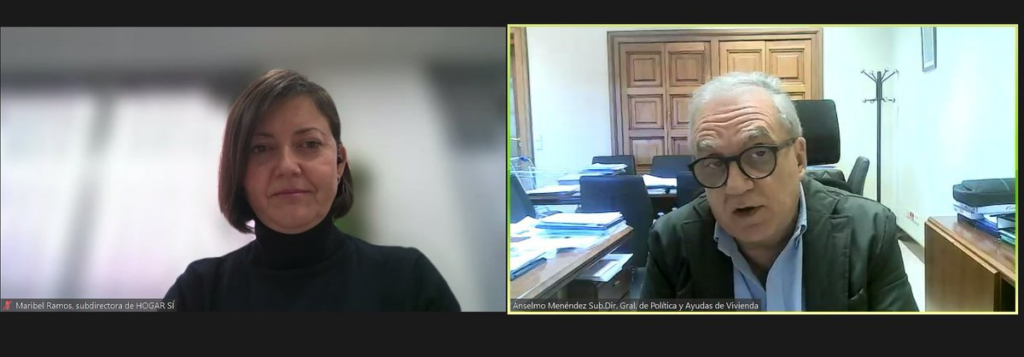
The day was structured in two round tables and a space on the challenges of improving the implementation of the PEAV 2022-2025 to combat homelessness, in which those aspects that represent an opportunity were discussed in depth, reviewing some of its programs:
- Program 3, to help victims of gender violence, people who have been evicted from their homes, homeless people and other particularly vulnerable people.
- Program 6, to increase the public housing stock.
- Program 8, for the promotion of temporary housing, cohousing models, intergenerational housing and similar models; and
- Program 10, to promote the provision by the Autonomous Regions and municipalities of housing for rental as affordable or social housing.
In this context, the reform introduced by RD 903/2022 and which modifies the State Plan for Access to Housing, whereby the implementation of Program 3 is no longer mandatory, which reduces its importance, was also discussed. And Programs 3 and 8 were highlighted as the main contributions of the PEAV to the homelessness strategy, recommending as an aspect for improvement the articulation of mechanisms by the Autonomous Communities that incorporate the financing of social accompaniment for people who require it, promoting cooperation between Housing and Social Services.
The first roundtable, involving the Ministry of Social Rights and Agenda 2030 and the Ministry of Transport, Mobility and Urban Agenda (MITMA), addressed the opportunities presented by the new homelessness strategy and the EAPH within the framework of the European Platform to Combat Homelessness. The main topics highlighted were:
- To recognize housing as one of the main social problems we have in Spain and which conditions people's opportunities.
- The importance of working in collaboration between the departments of Social Services and Housing at the state level, but also at the regional and municipal levels (where these policies are implemented), taking into account the specific assistance required by certain groups such as women victims of gender violence and young people, for the design of an appropriate strategy to end homelessness.
- The commitment and planning of many entities involved and the tools available to meet this great shared challenge, including financing instruments such as the PEAV, the recovery mechanism and the structural funds, which allow the financing of the housing and assistance binomial.
- From the point of view of state housing policies, MITMA's capacity for general regulation and financing of housing access programs was pointed out, while the importance of the Housing Sectorial Conference reaching concrete agreements to ensure that no one lives on the street was stressed, assuring the Ministry's commitment and collaboration.
- The possibilities offered by Program 3 of the PEAV, focused on vulnerable groups, with which the autonomous communities, through State funds, can provide homeless people by direct award with 100% assistance to find an immediate and dignified residential solution, with an additional amount for expenses.
The second round table showed the experiences of the Autonomous Communities using the State Plan for Access to Housing and its potential to solve homelessness.
The representative of the Region of Murcia gave a positive assessment of the application of the previous PEAV, explaining its implementation and the changes they had introduced to improve it, which could serve as an example for other administrations:
- For the development of program 3, they informed that they channel the aid through collaborating entities for the care of vulnerable groups, which work jointly with the Department of Social Policy and the municipalities.
- As a change, they pointed out that they have eliminated the financing of supplies through this program (due to problems of justification and bureaucracy); pointing out, however, that they now use other instruments, such as electricity or water social vouchers, to reduce the cost of these supplies.
- Regarding program 6, the possibility of using state financing to acquire housing from SAREB and convert it into social housing was highlighted.
On the other hand, the main lessons learned by the General Directorate of Housing of Andalusia throughout its experience were:
- To have a broad perspective and the need for coordination between departments to increase outreach; conceiving housing as the main housing solution, rather than other types of resources.
- The existence of two lines of financing: one aimed directly at vulnerable people and the other at third sector entities that facilitate access to housing for people in a situation of special vulnerability.
- Improve the current Plan, removing the obligation for Social Services to issue a document accrediting the situation of vulnerability, which was a major obstacle to accessing aid.
- To echo, for future improvements, the requests of social entities such as Provivienda and HOGAR SÍ, which we request the elimination of certain requirements (such as the existence of a rental contract to access aid), as they are a reason for the exclusion of homeless people.
We can conclude that this meeting between the departments of Social Services and Housing was a very enriching space from which we obtained the commitment of the administrations to work to solve the problem of access to housing and to end homelessness, the importance of close collaboration between the different departments of the administration to provide more far-reaching responses and the need to incorporate the lessons learned from previous experiences to enhance future plans and guarantee the right to housing for all people, especially those in situations of greater vulnerability.