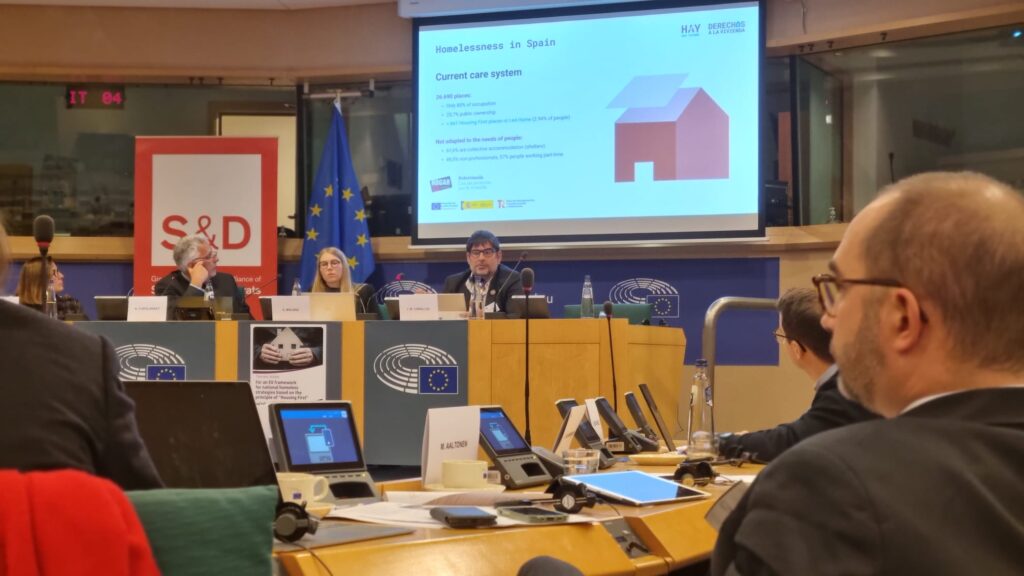
The work carried out in the Housing Rights and H4Y FUTURO projects is serving as a reference for other third sector organizations and public administrations. For this reason, on Tuesday, November 14, the alliance HOGAR SÍ and Provivienda was invited to the European Parliament to talk about innovative solutions to homelessness. Representing both teams, José Manuel Caballol, director of HOGAR SÍ, spoke about the lessons learned and challenges related to this common cause. Today, November 21, the debate continued at the European Economic and Social Committee (EESC), where both meetings took place, with the support of the Spanish Presidency of the Council.
The objective of the EESC is to provide a space for dialogue and exchange among civil society organizations in the member states. In Caballol's words, "it has been a pleasure to share space with other colleagues who are working towards the same goal, allowing us to confirm that there is a unanimous view on homelessness as a structural cause". The main aim of both meetings is that the European Commission elected in 2024 commits itself to certain lines of action.
As a joint conclusion, Caballol adds, "this situation requires solutions that go from the management of homelessness to its eradication; a transformation of the system to move from shelter care to the prioritization of housing as a solution; the incorporation into the European political agenda with a plan linked to the Commission's legislature and its reflection in the six-monthly actions; and, last but not least, a financing plan by the European Commission."
The presentation by the director of HOGAR SÍ was part of the panel entitled "Pilot projects and case studies on homelessness: Spain, France, Scotland". Ákos Topolansky, moderator on behalf of the EESC itself, held as the thematic axis the strategies based on the principle of "Housing First".
Patricia Benazurtea Barrio, General Director of Family Diversity and Social Services, opened the dialogue. In her speech, she highlighted some of the actions framed in the National Strategy for the Fight against Homelessness in Spain 2023-2030, based on human rights with a human rights approach.The aim of this strategy is to move towards a different model that puts each person at the center through specific funding. He also recalled that homelessness, as well as all the associated problems that lead to extreme exclusion, must focus on access to housing.
Other expert voices present at this event were Laure Billoret, project manager at DIHAL (Interministerial Delegation for Housing and Access to Housing) representing the teams that have driven the implementation of the Housing First model in France; and Solene Molard, Policy Advisor at Eurocities, presenting case studies such as those of Lyon or Glasgow.
During today's session, María del Carmen Barrera Chamorro, Vice-President of the EESC Workers' Group, took the floor in defense of "an EU framework for national homelessness strategies based on the Housing First principle". In her speech, she spoke of the need to strengthen the continuity of the European Platform to Combat Homelessness, calling for the development of a specific strategy for the same that allows the integration of national strategies in the European semester. He also wanted to highlight the "failure of erroneous perspectives on homelessness, based on welfare and emergency".
In line with the intervention of José Manuel Caballol, María del Carmen Barrera also expressed concern about the increase in homelessness: "in the opinion we ask that a European investigation be initiated on this growing problem and that progress be made in the statistical analysis also by way of denunciation, a matter that would force us to get out of the opacity normalized in Europe around homelessness".
Among the innovative solutions implemented by Housing Rights and H4Y FUTURO, Caballol wanted to highlight the following: orientation towards autonomy and exit from the care system, focus on the community and improvement and requalification (upskilling & reskilling) of acquired professional skills.
Finally, as a conclusion shared in both sessions, the speakers stressed that public policies are needed not only to eradicate homelessness, but also social policies so that, in the words of María del Carmen Barrera, "people can regain control of their lives after leaving this situation.