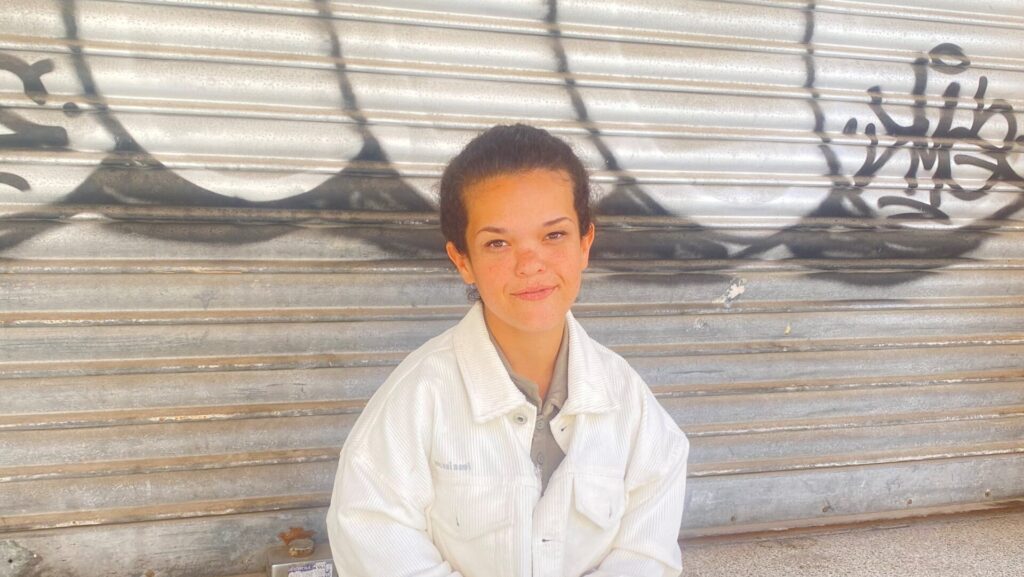
Marisol still finds it hard to put in chronological order what she has lived through so far.She is only 22 years old, but her experiences are heartbreaking. "Right now we are in the phase of putting our experiences in order. People who have been on the street often have problems to establish in time the events that have happened to them," says Mamen, the HOGAR SÍ technician who has given Marisol back the will to live. This young Mallorcan is one of the more than 6,000 people between 18 and 29 years old who are homeless and living on the street, in settlements or, if they are a little "luckier", in a shelter.
Marisol did so for more than a year in an abandoned car until a Red Cross team that went every day to check on her told her about the possibility of entering a program of HOGAR SÍ and Provivienda(H4Y FUTURO) aimed at homeless youth.
But up to this point, "when the sky opened up", it is inevitable to ask Marisol how she ended up on the street. "It has been an accumulation of circumstances and also of bad decisions. A woman adopted me when I was four years old, she took me out of the children's home where my biological parents had left me, but my relationship with her was never good. It is true that materially I never lacked anything, but she did not give me the affection that a mother should give to a daughter. So as I grew up our relationship went from bad to worse. I have to say that I didn't make it easy either, but it was unsustainable", says this Mallorcan to La Razón.
So when she turned 18 she decided to leave home. "My mother told me not to come back if I left. I didn't care, I couldn't stand living with her anymore. But I didn't know that what was coming was going to be much worse. Sometimes we young people don't have our heads where they should be," she admits.
She met a guy with whom she moved in. "At the beginning everything was fine, he was a very nice guy, he treated me very well. honestly, I trusted him. But after a while things changed and he started to mistreat me".
She still gets nervous remembering that episode: "If I lost a sock, he would beat me up. Anything was a reason to beat me up. He would chase me when I went out until he decided to lock me up. He would put me in a room and put a lock on it so I couldn't get out. My face would swell up from the blows he gave me. It was hell. One day I was able to escape, I took my papers and ran out of that house. Later, of course, I reported him and he was convicted of abuse," says Marisol.
But this escape did not bear fruit either. He wanted to return to his mother's house, "but she closed the doors, she told me that she had already warned me that if I left her house I was not to return, so I had no choice but to look for a living in the street. I had 1,900 euros in my account and I thought that would be enough to get by, but it wasn't like that. I bought a car without an engine and that's where I lived for more than a year".
"Many complexes"
At the age of 20, he thought his life had come to an end. He drowned his ills in alcohol and cannabis in what became a loop from which he could see no way out. "I didn't have enough to eat. I didn't even have ten cents to buy something in a supermarket or a coffee shop to go to the bathroom, so I had no choice but to relieve myself in parks and wash my clothes in some fountain. I had nowhere to shower. As you can understand, nobody wanted to hire me for any job. Besides, the neighbors would denounce me for having my car on the street," he says with anguish.
Marisol recognizes that her lack of esteem is, in part, what also unleashed this whole concatenation of misfortunes. "I was always a withdrawn girl. At school I had a hard time because they picked on me and I withdrew from everyone. In fact, to this day, I always choose places where there are no people, it's something I have to work on. I have to get rid of my complexes.
Her complicated background has also made her distrustful of everyone: "I think that they are going to cheat me, that if they offer me something it is because they are going to ask me for something else in return. When I was living on the street I was very scared, they tried to rape me on several occasions".
According to data from HOGAR SÍ, 42% of this group has been the victim of a crime or aggression. "Similarly, homelessness violates other rights such as health: 26% of homeless people in this group claim to have a chronic illness," they point out. According to INE data, homelessness affects about 28,000 people in Spain, "however, from HOGAR SÍ we estimate that the figures are higher, 30% more, than those shown in the survey because they only take into account people who attend homeless care centers, without taking into account those who remain outside the system and we know they exist".
According to the same association, the reasons why young people become homeless are very varied: "Having to start from scratch after arriving from another country accounts for 57%, 11% because they or their children have suffered violence, 11% after leaving a juvenile center, 9% after losing their job and 7% because they were evicted from their home".
At this point in Marisol's story, she begins to smile. "Without expecting it, one day, a Red Cross team that often stopped by my car to give me something to eat or to ask me how I was doing, told me that there was a program to help people in my situation. I told them that I didn't believe them, that it was impossible. How could they offer me a house without asking me for anything in return". But they did.
Horseback riding on the beach
She entered the "H4Y FUTURO" program organized by HOGAR SÍ and Provivienda , which has already given housing to more than 100 young people. "They are my saviors, I now live in a house for which I pay nothing in exchange for getting my independence in a year. They help me prepare for the job market, help me build my resume. I never thought I could get out of the hole I was in," she admits. Her day-to-day life is now completely "different and hopeful": "I dream of working as a clerk, of being able to pay for my own house. My goal is to become a responsible person and be able to lead a normal life. I made many mistakes that led me to the street, but I can't waste this opportunity," she says.
According to the experts working with her to help her get through it, "I still have a long way to go, but at least now I feel like I want to go on living, I'm happy and cheerful". She has already managed to kick her addiction to alcohol and is gradually gaining self-confidence.
"There came a time, when it was so bad, that I didn't want to go on, now I have a dream I want to fulfill: to ride a horse along the beach." Maybe this too will come true.
Housing First" Methodology
The profile of young people like Marisol with whom HOGAR SÍ and Provivienda work with are people between 18 and 25 who were previously living in shelters, on the streets or in settlements. "We have worked with more than 200 people of whom a total of 105 have accessed the program. Of these, 20% are women, who represent a profile that is very invisible when we talk about homelessness," Tamara Serralvo, the coordinator of the H4Y FUTURO project, explains to this newspaper.
The reasons that lead these young people to end up on the street are "unique and multifactorial: "The only circumstance that unites them is being in a situation of vulnerability and having suffered experiences that have led to traumatic situations at a time when vital development is very important". For this reason, the experts who work with these young people do so from the point of view of accompaniment "since they are the ones who decide where they want to go in their future". In addition, Serralvo stresses that "we intend to strengthen the competencies of public administrations related to early care of homelessness in young people through the Housing First for Youth methodology".
Ángel Nieto Lorasque.
Source: La Razón