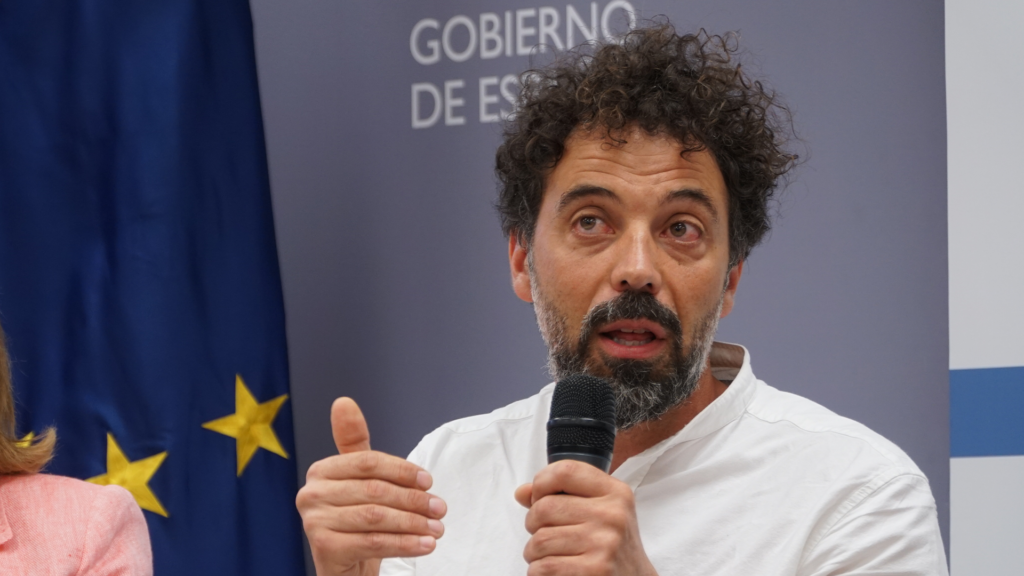
Interview with Marco Antonio Luengo, director of the Social Services Foundation of Gijón.
Homelessness in Asturias presents several particularities, but there is a data that stands out in the Homeless Survey 2022 conducted by the INE, and that can be encouraging: 30% of homeless people have been homeless for less than six months, one of the best data at national level.
Gijón, the most populated city in the Principality of Asturias, is one of the three points where most of the homeless population in the autonomous community is concentrated. According to the Municipal Foundation of Social Services of the City Council of Gijón, a public institution that manages social services and care for the most vulnerable people in the municipality and plays a key role in the fight against homelessness, nearly 80% of the homeless population is concentrated between Gijón, Oviedo and Avilés.
To understand this context, we spoke with Marco Antonio Luengo, director of the Municipal Foundation of Social Services of the City of Gijón, to learn more about this social problem and the response that has led to these results in Asturias.
The particularities of homelessness care in Asturias and Gijón
Several professionals in the care of homeless people in the country state that the response to this problem in Asturias has some peculiarities. Marco Antonio Luengo points out that this is due to the good relationship between the three municipalities, the Government of the Principality of Asturias and the Regional Ministry of Social Rights and Services, which allows for better coordination. In addition, "the level of knowledge of the professionals of the entities and the municipalities, as well as of the homeless people, is high due to the size of the community". This allows a more personalized work and adapted to the needs of each homeless person.
The benefits of collaboration between Housing and Social Services in the eradication of homelessness
Housing is a fundamental element in the eradication of homelessness and that is why collaboration between Social Services and Housing is essential. Asturias is a good example of how this collaboration has good results.
According to Marco Antonio Luengo, the approach model in Gijón includes three axes: housing, accompaniment and minimum income and "the lack of any of them prevents the success of the process". The good news is that the Principality of Asturias has a public housing stock that includes "more than two thousand homes and homeless people are a priority group to access them", according to the director's words.
Housing is also essential to care for people with a long journey on the streets. According to data from the Survey of Homeless People (2022), 61.8% of the homeless population in Asturias has more than one year in this situation, which is similar to the national average. About this, Marco Antonio points out that "there are many formulas to support people to have their housing, but people who have some important processes of exclusion, physical or mental health difficulties, the level of support or protection of housing has to be high. In this sense, the bet for people in a situation of homelessness, who have a street route, we consider that it is public housing, rather than support for the maintenance of private housing".
Therefore, public housing and community support are key to the eradication of homelessness in Asturias and specifically in Gijón.
The innovation project Housing rights as a driver of change in homelessness care
Housing Rights is an innovation project that seeks to change the homelessness care system and believes that decent housing is the starting point for the recovery of people's rights.
In Asturias it is being developed in two cities, Gijón and Avilés, with the participation of the respective city councils and the Principality of Asturias. For Marco Antonio Luengo, the Housing Rights innovation project in the city will have an impact beyond the care provided to the homeless. First of all, the project allows access to housing for about 45 people, that is, about a "third of the people in a more severe situation of exclusion", which means a significant improvement in the quality of life of these people.
In addition, the project is aligned with an approach to homelessness based on housing and support models, rather than generating other resources or increasing the number of places for other types of resources. "This project is very much aligned with our own way of understanding the approach to homelessness which has to go on the one hand towards housing and accompaniment models rather than generating other resources or increasing the places of other types of resources. In that sense, this model suits us very well, it has a very positive impact because it is also being incorporated into the city's narrative, which is the need for this approach and then also because it allows us to address another important issue, which is prevention".
This focus on prevention is crucial to prevent groups such as migrants, people in exile, women in situations of precariousness or gender violence, or people with severe mental disorders, from ending up on the street. "There are a number of groups that are most at risk of being on the street and it is a challenge to empower and prevent the situation absolutely and not have to start with situations of working from the street".
In summary, the project will have a significant quantitative and qualitative impact on the city and is an important step in the fight against homelessness.
The challenge of prevention to solve the problem in the future
Finally, regarding the challenges for the future and a point of improvement of the deinstitutionalization strategy is prevention: "In the end, many people become homeless because other issues have previously failed and because the welfare system has been expelling certain people from its system and then they end up on the street".
The solution, for Marco, lies in housing: "If there is no minimum access to housing for the most economically disadvantaged groups, we would be continually working to get people off the street and we think that the homelessness strategy should improve considerably.