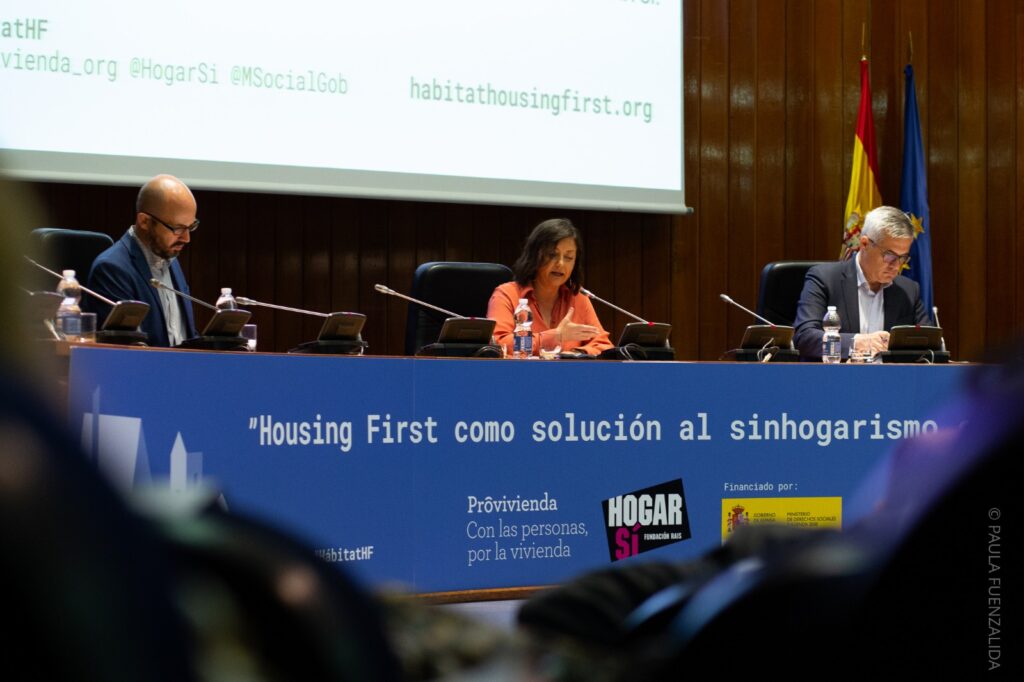
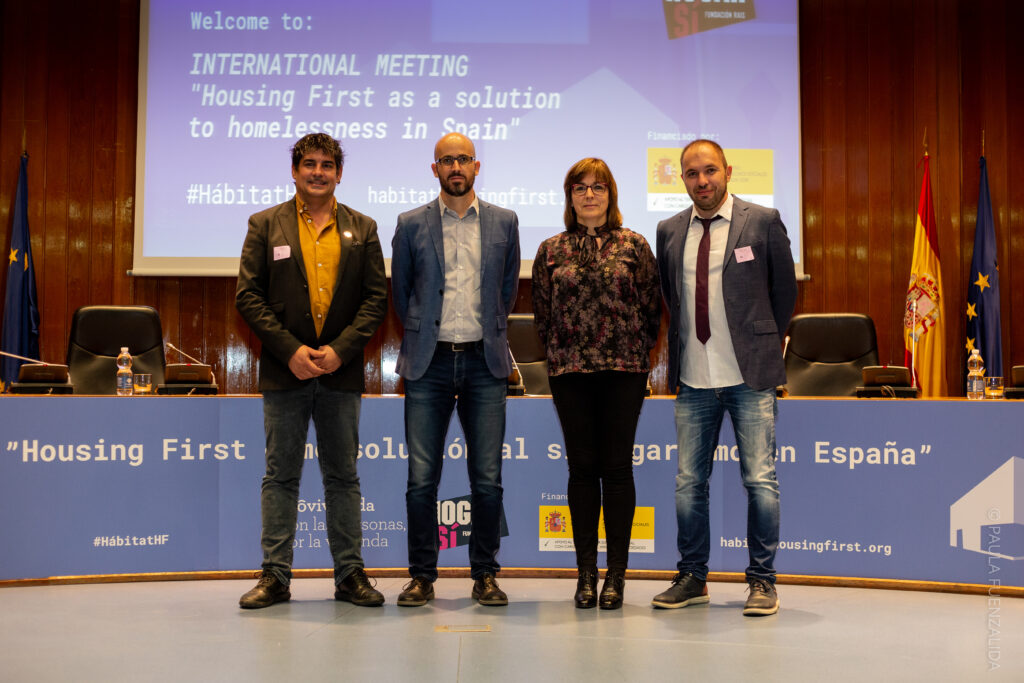
- HOGAR SÍ, PROVIVIENDA and the Ministry of Social Rights and Agenda 2030 organize the International Meeting "Housing First as a solution to homelessness in Spain".
- The meeting was attended by Ignacio Álvarez, Secretary of State for Social Rights of the Ministry of Social Rights and Agenda 2030, andDavid Lucas, Secretary General for the Urban Agenda and Housing of the Ministry of Transport, Mobility and Urban Agenda.
- The conference was attended by international speakers such asJuha Kaakinen, CEO of Y-Foundation,Freek Spinnewijn, director of FEANTSA and Geert De Bolle, coordinator at Housing First Belgium Lab, who discussed the effectiveness of the Housing First methodology in other European countries such as Finland.
Madrid, October 20, 2021- HOGAR SÍandProviviendatogether with theMinistry of Social Rights and Agenda 2030, have held the International Meeting "Housing First as a solution to homelessness in Spain", where the results of the first evaluation of the Housing First methodology in Spain have been presented.
It is currently estimated that there are between 30,000 and 40,000 people in Spain who are homeless, and that 12.6% of the population has had their right to housing violated at some point in their lives.
Housing First is a social intervention methodology that breaks with the traditional staircase model of care and provides homeless people with individual, stable and independent housing with professional support according to their needs and demands.
This methodology focuses on homeless people with disabilities, mental health problems and/or addiction problems, and therefore helps people with the most vulnerable profiles, who come directly from the street or who are referred through entities that work in emergency arrangements. In Spain, HOGAR SÍ and PROVIVIENDA are pioneers in setting up Habitat a program that has been developed under this methodology since 2014. It currently has 287 homes in eight Autonomous Communities.
International speakers at the meeting includedJuha Kaakinen, CEO of Y-Foundation,Freek Spinnewijn, director of FEANTSA and Geert De Bolle, coordinator at Housing First Belgium Lab, who discussed the effectiveness of the Housing First methodology in other European countries such as Finland.
"The current government in Finland has set a goal of ending homelessness by 2027, and it will be by employing Housing First. There is a challenge to this methodology: it's not just about housing, although that comes first, you also need to assess and respond to each person's support needs on an individual basis, based on their life stories," explains Kaakinen.
Ignacio Álvarez, Secretary of State for Social Rights of the Ministry of Social Rights and Agenda 2030, and David Lucas, Secretary General for the Urban Agenda and Housing of the Ministry of Transport, Mobility and Urban Agenda, also participated in the symposium "Housing as a solution to homelessness". According to Ignacio Álvarez, "putting the focus on housing is crucial to fight poverty and social exclusion. Housing First has demonstrated results and it is time for it to be developed as a public policy". For his part, David Lucas added about the State Law on the Right to Housing that this law "is born with the vocation that housing becomes one of the basic pillars of the Welfare State of our country".
At the meeting, the results of the first evaluation of Housing First evaluation on Housing First developed by the Fresno consulting firm and researchers Sonia Panadero and Juan Martín of the Complutense University of Madrid . This evaluation demonstrates the effectiveness of this methodology to eradicate homelessness through the changes that occur in people who have stopped living on the street or in other spaces such as shelters and emergency shelters when they have direct access to individual and stable housing.
The program's main indicator of success is the 96% housing retention rate, that is, almost all of the people who access a house remain in it after 18 months. "The Habitat program didn't just provide me with housing, it provided me with a home. When I was offered to enter the program I felt it was something new, different, individual; I had the feeling that the whole team was working for me. It gave me back my self-esteem and my dignity" Andrés Alarcón, former Habitat Program participant in Mallorca.
Both organizations have emphasized that the Housing First model in Spain offers economic advantages. The evaluation shows that this solution has a cost per place similar to that of shelters or group housing, but offers superior benefits to users in terms of stability and quality of accommodation and personalized assistance.
"Homelessness has a solution and our country has the obligation to put an end to it in the coming years. Our government's commitment to meeting the SDGs and the 2030 Agenda is clear. The acceptance of these goals by companies, institutions and citizens is encouraging and should lead us to eradicate this serious violation of human rights in the next two legislatures," said José Manuel Caballol, CEO of HOGAR SÍ.
In Spain the implementation of this methodology is still a minority, however, from both entities claim to be facing great opportunities, such as the Next Generation EU funds, to increase the commitment to this solution to homelessness. " The State Housing Plan 2022 - 2025 and the State Law for the Right to Housing will be extremely important to expand the stock of affordable and social housing, both for scaling up solutions to homelessness and also for the necessary link between housing and social services," concludes Eduardo Gutiérrez, deputy general manager of Provivienda.